
Quick answer
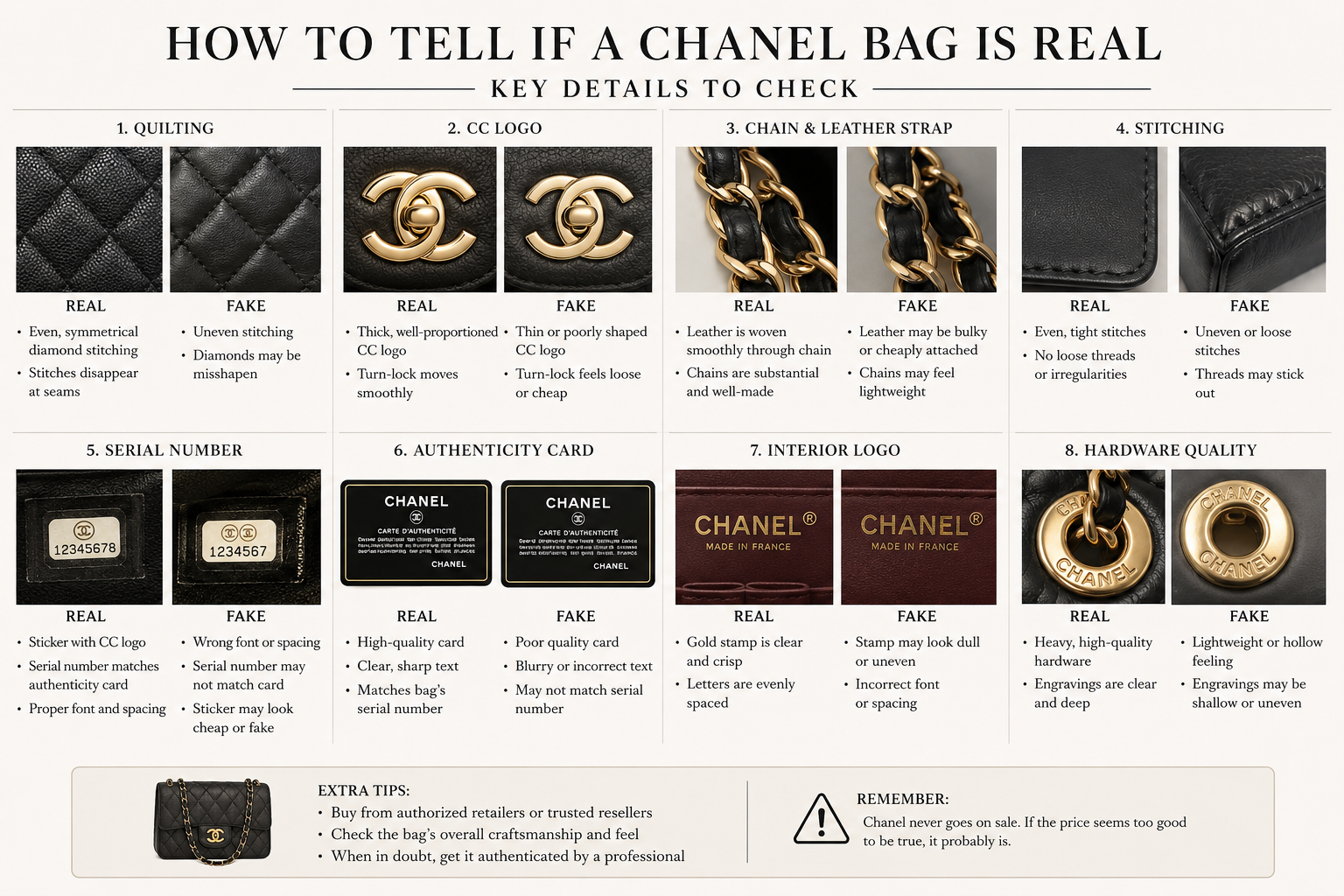
a real Chanel bag usually has precise quilting, tight even stitching, clean CC logo proportions, weighty hardware, sharp interior stamping, and period-correct serial or microchip details. A fake often gives itself away through mismatched quilting, loose threads, thin hardware, bad font spacing, messy stamping, or a price that does not match the market.
Chanel authentication checks at a glance
- Quilting should line up across the flap, pocket, and seams.
- Stitching should be tight, even, and dense rather than loose or wavy.
- The CC turn-lock should look balanced and move smoothly.
- Chain hardware should feel substantial, not hollow or tinny.
- The leather should match the model and age: lambskin, caviar, calfskin, tweed, or seasonal material.
- Interior branding should be crisp, centered, and evenly spaced.
- Serial stickers apply to older bags; newer Chanel bags use a metal plate or microchip-style identifier instead of the old authenticity card system.
- Seller story, receipt, box, dust bag, and price should support the bag, not distract from weak details.
Start with the quilting
The fastest first check is quilting match. On many Chanel flap bags, the diamond quilting should continue cleanly across the front flap and pocket. The diamonds do not need to look machine-perfect on every vintage or heavily used bag, but the pattern should make sense. If the quilting breaks awkwardly at the flap, shifts badly at the pocket, or looks puffy on one side and flat on the other, slow down.
Next, look at the stitching. Chanel bags are known for tight, controlled stitches. Counterfeits often use wider, looser stitching because it is cheaper and faster. Count is not the only test, because different models and eras vary, but the stitching should be straight, secure, and consistent. Loose threads, uneven stitch length, and corner stitching that looks careless are bad signs.
Check stitching and the CC logo
The CC logo deserves close attention. On a classic turn-lock, the proportions should look balanced rather than skinny, stretched, or oddly spaced. The lock should turn smoothly. It should not feel loose, crunchy, or light. Bad fakes often get the logo close enough for a quick photo, then fail when you look at the thickness, curve, and finish in person.
Hardware is one of the easiest places to feel the difference. Authentic Chanel chain straps and turn-lock hardware usually have a solid feel. The chain should not feel like costume jewelry. Engravings should be clean, not shallow or fuzzy. The leather threaded through the chain should sit neatly without looking bulky, twisted, or glued in place.
Feel the chain, lock, and leather
Leather and shape matter too. Lambskin should feel soft and rich, but not plasticky. Caviar leather should have a pebbled texture that feels structured, not rubbery. A real Chanel flap should hold its shape in a way that matches its age and use. A twenty-year-old bag can show wear. It should not look newly made and badly built at the same time.
Do not rely too much on the authenticity card. Chanel stopped using the old authenticity card system on newer bags, and older cards are widely copied. For older bags, the serial sticker and card should match and look period-correct. For newer bags, expect a different identifier system. If a seller uses a card as the main proof while the stitching, stamp, and hardware look wrong, walk away.
Serial stickers, cards, and newer Chanel identifiers
The interior stamp is another strong clue. The CHANEL stamp and country-of-origin line should be sharp, centered, and evenly spaced. Letters should not look melted, crowded, dull, or crooked. Some genuine vintage bags show fading, but fading is different from a bad stamp. A weak stamp on a supposedly barely used bag is a warning sign.
Check the bag against its model and year. Chanel changes details across seasons, so you need to know what should exist for that exact model. A Classic Flap, Boy Bag, 2.55 Reissue, Chanel 19, Chanel 22, and seasonal vanity case do not all follow the same rules. The wrong lining, wrong chain style, wrong plate system, or wrong hardware finish can expose a fake even if the bag looks polished.
Interior stamp, model year, and seller risk
Price is not proof, but it is a useful filter. Chanel itself warns that poor stitching, misspellings, and logo mistakes are common signs of counterfeit products, and there are no Chanel factory seconds. If a seller claims a new Chanel bag is discounted because it is outlet stock, sample stock, or second quality, treat that as a serious red flag.
For resale purchases, ask for clear photos before paying: front, back pocket, side seams, base corners, serial or plate area, zipper pull, interior stamp, strap, hardware engravings, and receipt if available. Blurry photos are not neutral. If the seller avoids close-up photos of the stamp, corners, or identifier, assume there is a reason.
When to use a professional authenticator
A professional authenticator is worth the fee when the bag is expensive. Use your own inspection first to reject obvious fakes, then get a third-party check before sending serious money. The point is not to become paranoid. The point is to avoid buying a story instead of a bag.
Common mistakes buyers make:
- They judge from one photo of the CC logo.
- They trust an authenticity card without checking the bag.
- They ignore sloppy quilting because the seller has a receipt photo.
- They forget newer Chanel bags may not use the old serial-card setup.
- They chase a low price and explain away every warning sign.
If you only remember one rule, remember this: a real Chanel bag should be consistent. The quilting, stitching, leather, hardware, stamp, identifier, and seller paperwork should all tell the same story. When one part looks expensive and another part looks cheap, that is usually not a bargain. It is a problem.
Useful next checks
Chanel also warns that poor stitching, misspellings, logo mistakes, and “second quality” claims are counterfeit warning signs. See Chanel’s own anti-counterfeit notice here: CHANEL anti-counterfeit information.
Related Chanel guides
Use these guides when you want to compare model shape, leather wear, and craftsmanship details before buying.